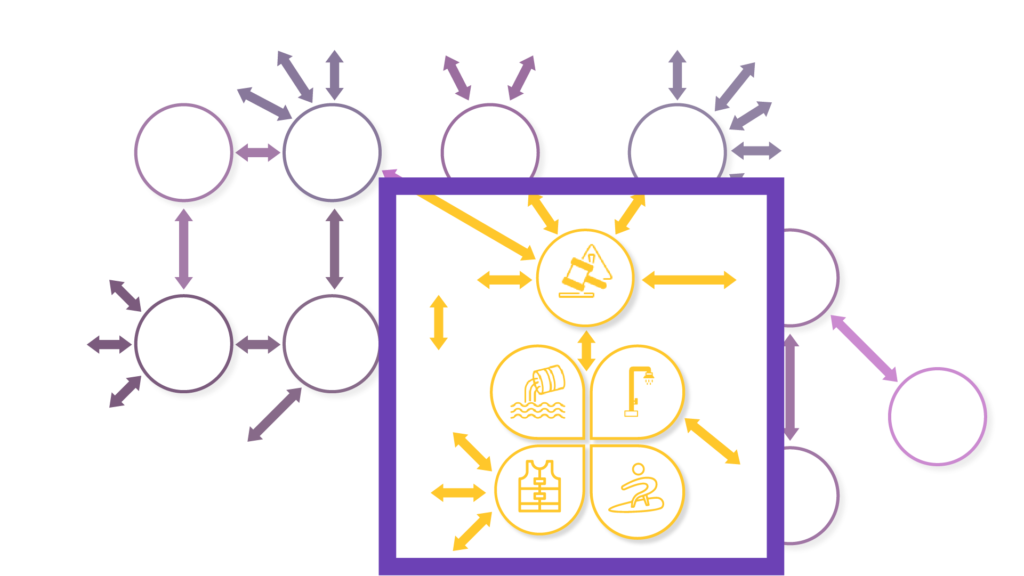
Infrastructure quality & usability positively affects the attractiveness of our Blue Spaces, which in turn affects its usage. Attractiveness is dependent on specific users and their personal choices (beauty is in the eye of the beholder) and may be even enhanced by the absence of the relevant infrastructure (e.g. for those Blue Space users that prefer the attractiveness of wild spaces). Attractiveness will also hinge on other factors, like, for instance, critical mass of users at a specific Blue Space. Some places are more attractive for visiting by families or kids. Such kind of attractiveness also varies, subject to specific age group of kids and family members. The attractiveness of a specific place may also depend on the versatility of the Blue Space.
Private land ownership can lead to a range of conflicts involving Blue Spaces and their users. Conflict between BS users includes conflicts between locals and visitors, between landowners and recreational users, etc. The conflict may have various manifestations / causes (lack of infrastructure segregation, too many cars etc.). These conflicts reduce “Use and accessibility”
The law may have ambivalent consequences. On the one hand, it may try to resolve conflict by imposing, for example, various by-laws and assigning statuses, like Blue Flag status, to a Blue Space. On the other hand, the imposed restrictions (e.g. restrictions for dog owners) may ignite conflict between users, acting in a conflict-reinforcing manner.
Anti-social behavior is an important factor which impacts the quality of Blue Space. It leads to misconduct & disturbance at Blue Spaces and often to the misuse of Blue Spaces, thus augmenting anti-social behavior. This Loop may also incorporate urban vs rural dynamics, which implies that, in the urban environment, the problem of anti-social behavior might be more pronounced. Antisocial behavior may also exhibit a group-related dynamic, involving anti-social gatherings, which stimulate inconsiderate behavior (e.g. thefts), supported by gangs. These factors augment personal unsafety, which further worsens antisocial behavior. It is an autocatalytic reinforcing Loop.
Excessive alcohol consumption could also exacerbate the problem of anti-social behavior, which in turn increases littering and in some situations stimulates bad attitudes & behavior of others, necessitating the need in imposing alcohol consumption regulation, which aims to diminish excessive drinking. This is a reinforcing Loop, and the success in reducing drinking-related antisocial behavior significantly depends on the quality of alcohol regulation, linked to adequate policy, enforcement & information.