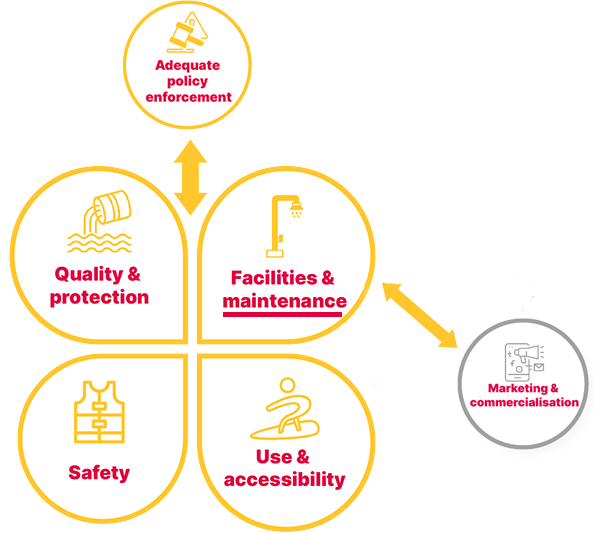
Facilities and maintenance

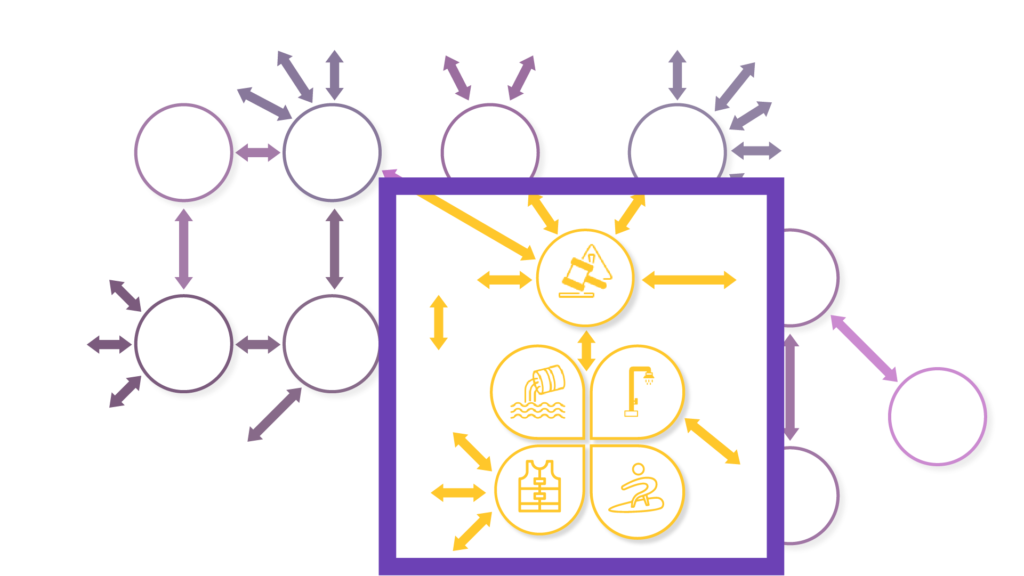
Many factors contribute to Blue Space quality and protection which is directly linked within the system to other variables through BS accessibility and use.

Read More

Blue Spaces Safety is directly linked to policy enforcement, quality and protection, facilities and management and use and accessibility.

Read More

Blue Space Use and accessibility is central to the Blue Space map, contributing to the health of the Blue Space but also its users.

Read More

Marketing of Blue Spaces is an important contributor to our economy and can have both positive and negative impacts on Blue Space quality.

Read More

“Facilities and Maintenance” relates to what facilities are available and how they are managed. During the data collection phase there were discussions related to what facilities users deemed suitable. These ranged from toilets, showers, litter bins to eateries.

External factors such as Ownership risk are becoming more influential in the provision of facilities. “Privatization” increases the need for insurance, which means that landowners start to face an increased risk of insurance claims, and that forces the owners to install more physical barriers, thus limiting access to Blue Spaces. Insurance might have a detrimental effect on the amount of Blue Space facilities as County Councils are reluctant to install more facilities because of the fear of insurance claims. Availability of “insurance” leads to improved “facilities & maintenance”, which substantiate the need in insurance.

Cost are also deemed as a barrier, costs are associated with transport and parking and access as well as related to accessibility and use of equipment. The rise in use, equipment & teaching costs (also linked to social, macroeconomic and other factors, including limited financial resources of various Blue Space users, as well as privatization practices) exacerbate financial barriers to use. Costs primarily relate to costs for various equipment and teaching practices associated with different Blue Space-related activities.

This is a well-known travel-related balancing feedback Loop reported by system dynamics (Sterman, 2000). Within this loop traffic volume boosts travel time and diminishes willingness to travel. When the latter drops, traffic volume drops too. This might be especially evident in the case of tourism-related travel routes, less associated with daily commuting. Willingness to travel is negatively affected by travel costs (Sterman, 2000). Travel time is positively affected by factors such as distance and negatively affected by transport capacity. The latter means that more developed road infrastructure and better transport facilities decrease travel time. Traffic volume might be also decreased by physical barriers.